Your First Padel Holiday as a Teen: What to Expect, Pack and Learn
-

- August 17, 2026

Going on a padel holiday with your family can sound exciting, slightly awkward or both.
Perhaps your parents already play and have spent weeks discussing courts, coaching and rackets. Perhaps you have never played and are wondering whether everyone else will be much better. You may also have a more important question:
Will I get any free time, or is every day going to revolve around padel?
A well-planned trip should leave room for both.
You might have coaching on two or three mornings, join one family match and still have afternoons for the pool, beach, sightseeing, shopping or doing your own thing. You do not need competitive experience—or any previous racket-sport experience—to take part.
The best first padel holiday gives you enough time on court to understand the game and improve, without making the trip feel like a training camp.
Quick Answer: Are Padel Holidays Suitable for Teenagers?
Yes. A padel holiday can work for complete beginners, social players and experienced junior competitors, provided the sessions match your age, ability and confidence.
| Question | Answer |
|---|---|
| Do I need previous experience? | No |
| Do I need to play tennis? | No |
| Will I need my own racket? | Often not; many venues offer equipment hire |
| Can I play with my parents? | Yes, especially in relaxed social games |
| Will there be other teenagers? | Not automatically; ask before booking |
| Can I join an adult group? | Sometimes, if the venue permits it and the level and safeguarding arrangements are appropriate |
| Will I play every day? | Only if that is the programme you choose |
| What matters most? | Level matching, suitable coaching, free time and a destination you enjoy |
LTA Padel says beginners do not need previous tennis or racket-sport experience. Padel is normally played in doubles, starts with an underarm serve and allows the walls to be used after the ball has bounced.
What Does a First Morning Usually Feel Like?
A typical first morning might look like this:
09:15: Meet the coach and explain how much—or how little—you have played
09:30: Short warm-up and basic racket control
09:45: Learn the serve, court positions and simple scoring
10:15: Practise forehands, backhands and volleys
10:40: Try letting the ball rebound from the back glass
11:00: Play short points or a simple doubles game
11:30: Finish, shower and meet the rest of the family for lunch
You are not expected to look polished.
Most beginners forget the score, stand in the wrong position or hit the glass accidentally. The first session is about making the court feel less confusing—not proving how athletic you are.
Do You Need to Be Good at Sport?
No.
Padel is relatively accessible because:
- The serve is underarm.
- The court is smaller than a tennis court.
- You normally share it with a partner.
- You can begin simple rallies before understanding every rule.
- The walls sometimes keep points alive.
The sport still becomes much more challenging as you improve. Better players need to understand positioning, net play, lobs, rebounds, shot selection and how to move with a partner.
That is why “easy to start” is more accurate than “easy.”
Tell the coach privately before the session if you have an injury, asthma, anxiety, a medical condition or a movement you need to avoid. You do not need to discuss personal details in front of the whole group.
What Will You Learn in Your First Lessons?
The Underarm Serve
You bounce the ball and serve diagonally into the opposite service box.
The first aim is simply to start the point consistently. You do not need to hit hard.
Forehands and Backhands
The coach will probably encourage a shorter, more controlled swing than you might use in tennis.
Large swings can be difficult to manage on a compact padel court.
Where to Stand
You and your partner should normally move forwards and backwards together.
One of the most common beginner mistakes is leaving one player at the net while the other stays at the back.
Volleys and Net Play
You may practise simple shots near the net and learn why this is often an important attacking position.
Using the Glass
The walls are usually the strangest part of the first lesson.
Once the ball has bounced on your side, you can sometimes let it rebound from the glass before returning it. The LTA advises beginners to create space, prepare early and read the rebound rather than crowding the wall.
A Short Game
The session may finish with:
- Simple points
- A longest-rally challenge
- Rotating partners
- Coach-led doubles
- A small social competition
Six Good Goals for Your First Trip
You do not need to learn every advanced shot.
A useful first-holiday target is to return home understanding:
- How to serve
- Where to stand
- How to keep a simple rally going
- How to move with a partner
- How to use the back glass occasionally
- Why control usually matters more than hitting everything hard
Nobody expects a new player to arrive knowing specialist shots such as a bandeja, vibora or bajada.
Will Everyone Else Be an Adult?
Possibly.
A package described as family-friendly does not automatically include a separate teen group.
Ask before travelling:
- Are other teenagers booked?
- Is there junior or teen coaching?
- What ages normally attend?
- Are groups organised by age, ability or both?
- How many players share each court?
- Is social match play supervised?
Junior standards also vary enormously. LTA Padel runs youth competitions for players of different ages and abilities, so one teenager may be taking a first lesson while another already competes regularly.
Can a Teenager Join an Adult Session?
Sometimes—but ability is not the only consideration.
A teenager should join an adult coaching group only when:
- The venue and coach permit it.
- The playing standard is appropriate.
- A parent or guardian has agreed.
- The provider’s safeguarding requirements are met.
- The session environment is suitable for an under-18 participant.
Ask for this to be confirmed rather than assuming that a confident teenager can simply join any adult class.
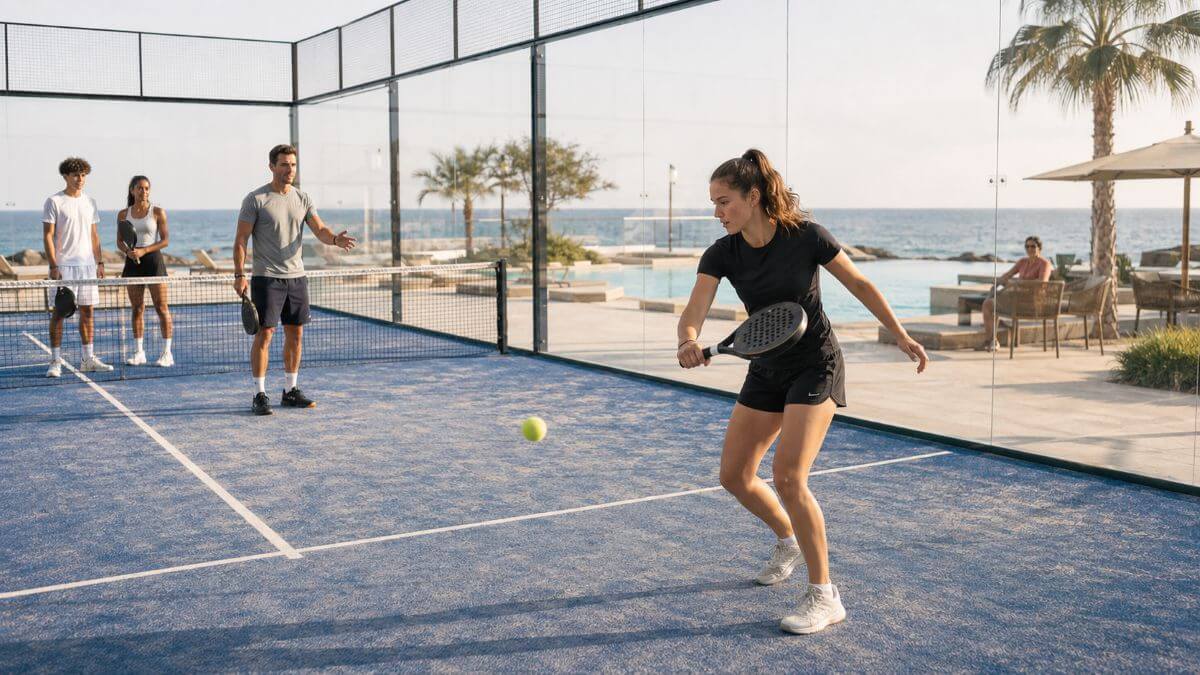
Is Playing with Your Parents Awkward?
It can be. It can also be one of the most enjoyable parts of the trip.
Parent-and-teen doubles usually work best when:
- Stronger players use control rather than power.
- Nobody gives advice after every shot.
- Partners rotate.
- The game stays social.
- Winning is not treated as the only point.
- You can stop when you have had enough.
One useful rule is:
During coaching, listen to the coach. During a family game, let everybody play.
How Much Padel Should You Book?
More court time is not automatically better.
For a first three- or four-night break, a balanced programme might include:
- Two coaching sessions
- One relaxed family or social game
- At least one free afternoon
- One day without compulsory padel
For a five- or seven-night holiday, three coaching sessions and one or two social games may be enough for many first-time players.
The schedule is probably too busy when:
- You are playing twice every day.
- Every afternoon becomes recovery time.
- All sessions are compulsory.
- You have no pool, beach or city time.
- You stop looking forward to playing.
- The whole family itinerary revolves around one person’s coaching.
Padel Holidays says the best trips balance suitable coaching and match play with comfortable accommodation and enough time to enjoy the destination. It also recommends checking club location and describing ability honestly before travel.
What Should You Pack?
You do not need professional equipment or a different outfit for every photograph.
Court Kit
Pack:
- Breathable sports tops
- Shorts, skort, leggings or sports bottoms
- Sports socks
- Supportive trainers or court shoes
- Cap or visor
- Refillable water bottle
- Small towel
- Sun cream
- Hair ties where needed
- Light warm-up layer
- Blister plasters
- Personal medication
Personal and Holiday Essentials
Also consider:
- Swimwear
- Sandals or casual shoes
- One or two evening outfits
- Spare underwear
- Period products where relevant
- Toiletries
- Sunglasses
- Phone and charger
- Portable power bank
- Plug adaptor
- Headphones
- Wet-kit or laundry bag
- A dry change of clothes after play
- Offline copies of the hotel address and family contact details
Do You Need Your Own Racket?
Usually not for a first trip.
LTA Padel says many venues allow children and beginners to rent or borrow rackets and balls, so you can try the sport without buying everything first. Reserve equipment in advance, particularly when travelling with a group.
Take your own racket when you play regularly and know what weight and shape you prefer.
Rent one when you are a beginner, have limited luggage or plan to play only once or twice.
Playing Safely in Hot Weather
Outdoor padel in Spain, Portugal or another warm destination is often more comfortable in the morning or early evening.
Bring water, use sun protection and take breaks in the shade. Tell the coach immediately if you feel dizzy, sick, unusually tired, very thirsty or develop a headache.
The NHS lists tiredness, dizziness, headache, nausea, excessive sweating, cramps and intense thirst among the possible signs of heat exhaustion in adults and children.
Do not try to “push through” feeling unwell simply because the session has been paid for.
What If You Need a Quieter or More Accessible Session?
A good provider should be willing to discuss individual needs before travel.
You might ask about:
- Step-free access to courts
- Accessible changing rooms
- Smaller coaching groups
- A quieter court or time of day
- A clear written timetable
- Extra breaks
- Private coaching
- Adapted equipment
- Reduced noise and fewer transitions
- Space for a parent or guardian to remain nearby
A neurodivergent teenager may find the session easier when they know the timetable, coach, group size and court layout in advance.
Do not rely only on a broad claim that a programme is “suitable for everyone.” Explain what would make it workable for you.
Will You Get Any Independence?
A teen-friendly holiday should include more than adult-organised activities.
Depending on your age, destination and family rules, you may want:
- Time by the pool
- Access to a gym or sports area
- Shops or cafés nearby
- Wi-Fi
- A walkable resort
- A separate sleeping area
- A choice over some excursions
- Time without the whole family
Agree the rules before the trip:
- Keep your phone charged.
- Save the hotel address offline.
- Agree a meeting place and time.
- Tell your parent or guardian where you are going.
- Keep your room number private.
- Carry the hotel contact details.
- Know what to do if your phone is lost.
- Do not leave the agreed area without permission.
Having independence is different from being expected to manage everything alone.
Choose Somewhere You Would Enjoy Without Padel
A great club cannot rescue a destination you dislike.
Look for a hotel or location with some combination of:
- Pool or beach
- Restaurants
- Shops
- Gym or sports facilities
- Boat trips
- Water park
- City or old town
- Evening entertainment
- Other teenagers
- Simple transport
Padel Holidays says its resorts are assessed for court quality, accommodation, location and the overall experience. That wider view matters when teenagers want free time and not every member of the family wants the same amount of padel.
Resort Holiday
Best when you want pools, beach access, simple meals and most facilities close together.
City-and-Coast Break
Best when you want restaurants, shopping, culture, beaches and a little more independence.
UK or Ireland Break
Best when you want a low-commitment first experience without flights or a full week away.
A Teen-Friendly Four-Night Itinerary
Day 1: Arrival
- Check in
- Explore the hotel or local area
- Pool or beach
- Dinner
- No padel
Day 2: First Lesson
Morning: beginner or level-matched coaching
Afternoon: pool, beach or free time
Evening: family dinner or local town
Day 3: No Padel
Choose a boat trip, water park, city visit, shopping or beach day.
Day 4: Second Session
Morning: volleys, positioning, glass and a short game
Afternoon: independent resort time
Evening: final dinner
Day 5: Departure
This gives you enough repetition to improve without making every day feel organised.
Ten Questions to Ask Before Booking
- Is the coaching suitable for my current level?
- Will there be other teenagers?
- Are groups arranged by age, ability or both?
- What safeguarding rules apply to under-18 players?
- How long is each session and how many people share a court?
- Are rackets and balls included?
- How far is the club from the hotel?
- How much free time will I have?
- What can I do away from the court?
- Can I skip or change a session if the programme is not right for me?
UK Travel Checks
Most formal arrangements will be handled by a parent or guardian, but you should still know:
- The hotel name and address
- Where your passport is stored
- Your insurance provider
- Your parent or guardian’s phone number
- The local emergency number
- Where medication is kept
- What to do if your phone or wallet is lost
GOV.UK advises travellers to check passports and entry rules, arrange insurance covering all planned activities and carry backup copies of important travel information.
A GHIC or eligible EHIC may help with medically necessary state healthcare in participating destinations, but it does not replace travel insurance or cover private treatment and repatriation.
If travelling with only one parent or guardian, the adult must normally have permission from everyone with parental responsibility unless an applicable court order provides otherwise. A signed consent letter may be requested at the border.
Is a Padel Holiday Worth It for a Teenager?
It can be—particularly when you want a holiday that includes something active without being scheduled from morning until night.
Padel is social, relatively easy to begin and gives you a skill that can improve noticeably over a few sessions.
The right trip should provide:
- Coaching at your level
- Enough free time
- A hotel or destination you like
- Activities away from the court
- Some choice over the itinerary
- Space from your family when appropriate
- A schedule that does not exhaust you
The best first padel holiday is not the one where you play the most.
It is the one where you come home wanting to play again.
FAQs
Can You Go on a Padel Holiday as a Complete Beginner?
Yes. Choose a trip with introductory coaching, equipment hire and sessions grouped by ability.
Do You Need Tennis Experience?
No. Tennis may help with coordination, but padel has different rackets, walls, movement and tactics.
Will There Be Other Teenagers?
Possibly, but it is not guaranteed. Ask whether junior or teen groups are running during your dates.
Can You Play with Your Parents?
Yes. Parent-and-teen doubles can be enjoyable when teams are balanced and the game remains social.
Do You Need Your Own Racket?
No. Many venues rent or lend rackets and balls, although equipment should be reserved before travel.
What If You Do Not Want to Play Every Day?
Say so before the trip is booked. A good programme should preserve free time and should not force every family member into the same schedule.
Last reviewed: August 2026
Commercial disclosure: Padel Holidays contributed specialist trip-planning information to this article. Padel rules and junior participation were checked against LTA Padel, while UK travel and health guidance was checked against GOV.UK and the NHS.